
The Agentic Finance Landscape Report: Q1 2026 Edition
Written in collaboration with Cambrian teammates Ariel, Brian, Doug, Jason, Pili, Ricky, Justin Deible, Tatu, and Tumay.
Since we published the last edition of The Agentic Finance Landscape in December 2025, the market segment has experienced explosive growth. We have seen new projects emerge, with growing adoption, and autonomous agents that are leveraging crypto infrastructure. Consider this evidence: x402 payments continue to accelerate, with 15M+ transactions in the last 30 days and institutional partnerships with large companies like AWS and Stripe. ERC-8004 hit mainnet launch in late January, a measure to establish trust between agents and marketplaces.
Agentic Finance Landscape Report Q1 2026
This edition of the agentic finance report surveys the landscape of autonomous products that support retail participants in decentralized finance (DeFi). As before, we applied a strict bar for excellence: listed projects must be active and publicly available, with real users and live capital at work. Agents are categorized by product type.
Note: In this edition, agents that we previously classified as Liquidity Provisioning Agents and Lending Agents have been merged into a broader yield category, reflecting a broader trend of agents diversifying the methods by which they earn yield.
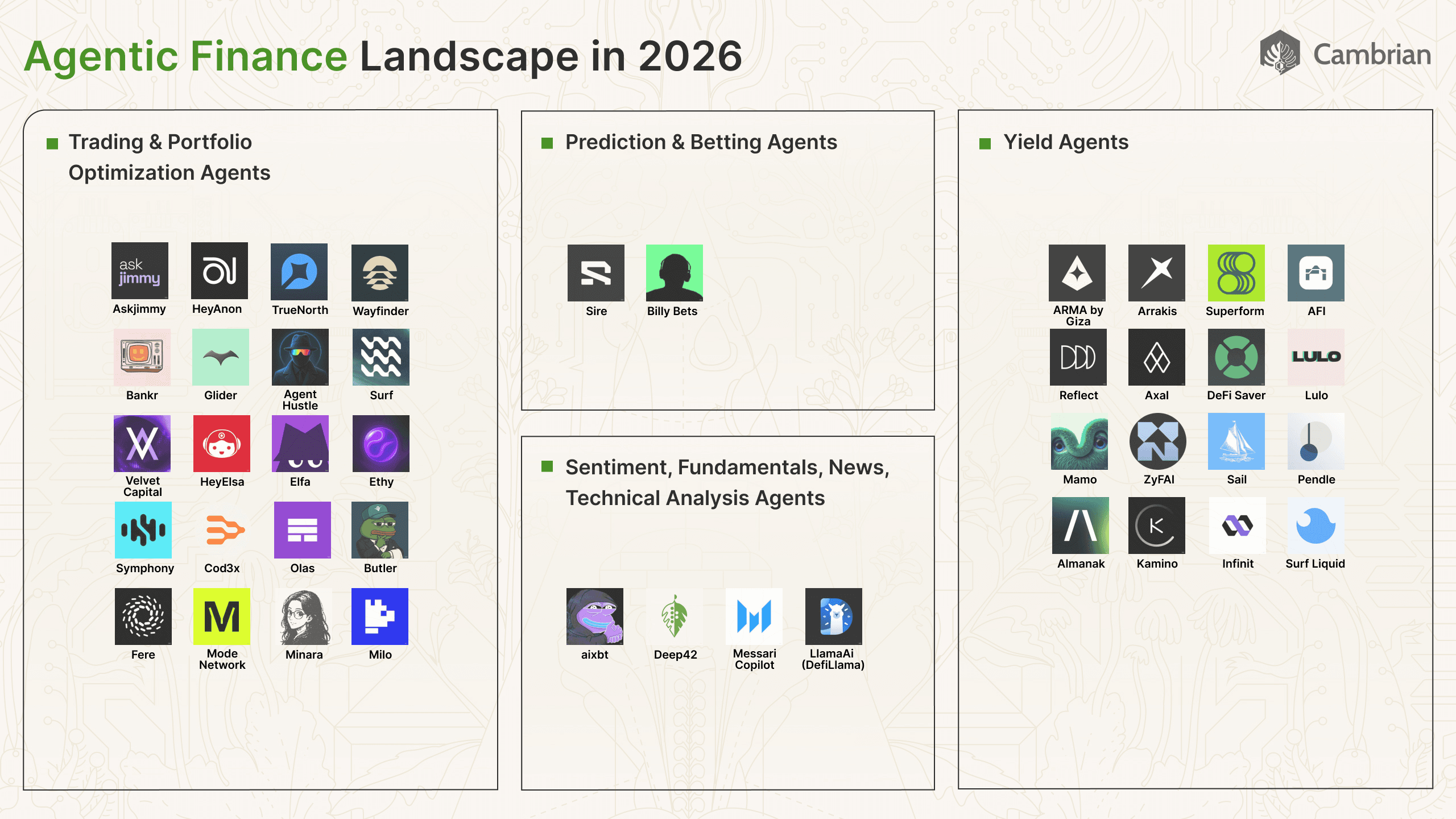
Jump down to learn more about each depicted project.
Table of Contents
- What is Agentic Finance?
- Autonomy vs. Intelligence in Agentic Finance
- AgentFi Market Growth in 2025-2026
- The Agentic Finance Landscape Q1 2026
- What’s next for Agentic Finance?
What is Agentic Finance?
Agentic finance is an emerging market segment of products that use automation to actively manage user funds or provide financial advice. Inspired by ChatGPT, Claude Code, and emerging open-source agentic tools like OpenClaw or Moltbot, some of these products use LLMs, while others employ hard-coded rules or traditional machine learning. Regardless of the underlying tech, many of them describe themselves as “agentic.”
The early days of agentic finance were about simple trading bots that automated execution. The DeFi Summer in 2020–2021 brought yield farming bots and vault protocols like Yearn that could harvest and compound autonomously, but the logic remained deterministic: if X is true, then do Y. By 2022–2023, automation had expanded across protocols and chains (bots managed collateral ratios, rebalanced LP positions, and hunted yield across lending markets) yet users still held the keys and set every parameter.
The first real shift came in 2024, when LLMs entered the stack, and we started seeing natural language interfaces, AI-powered analysis agents, and conversational trading. The decisive break happened in 2025, when, for the first time, the loop closed: agents that act according to strict rules without human approval. Today, agentic finance is a recognized market category, and the Cambrian team is proud to have pioneered the adoption of agentic finance and AgentFi to describe this niche. The products covered in this report represent the next major step in AgentFi’s progression: software that makes decisions, manages capital, and pays for its own existence.
Autonomy vs. Intelligence in Agentic Finance
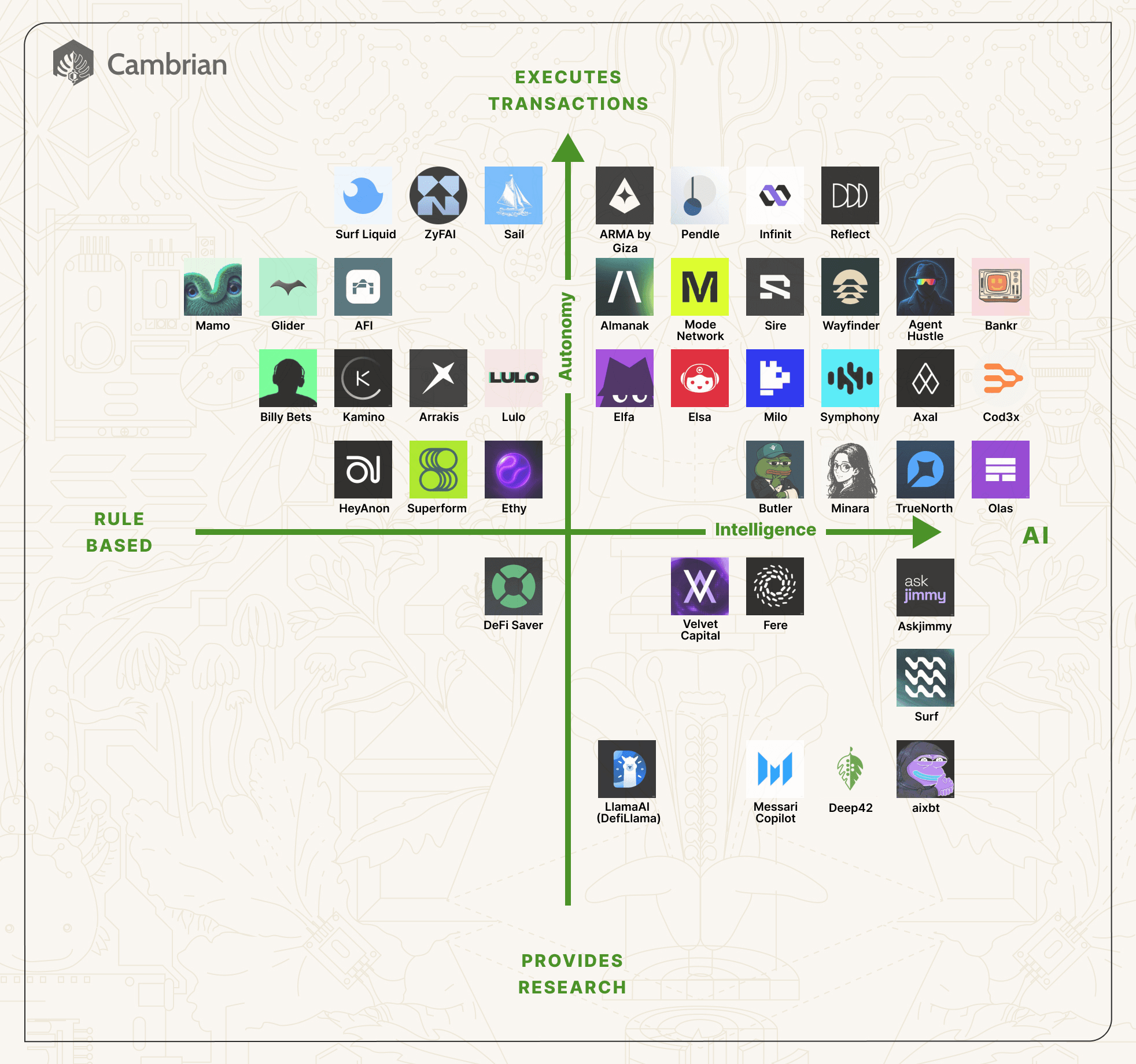
Agentic finance projects span specialized use cases, but each project can be placed on a simple compass. On the x-axis is intelligence: on the left, rule-based systems that rely on math and statistics; on the right, LLM-based systems (what many now call “AI agents”). The y-axis represents autonomy, ranging from tools that inform at the bottom, to human-in-the-loop systems in the middle, to autonomous systems that execute within policy without requiring permission at the top.
Since the first edition of this report, the center of gravity has shifted upward toward greater autonomy, while products with the most assets under management remain on the rule-based side of capital allocation decisions. LLMs are demonstrating their strengths in areas such as interface, information retrieval, and analysis. But when money moves, algorithmic, rule-based agents remain the norm for reliability and auditability.
AgentFi Market Growth in 2026
Growth Metrics
Since our last report, the ecosystem has continued expanding. Unique users for onchain AgentFi products continue to climb. Bankr and Giza are leading in user deposits over the last 30 days, with 900+ deposits each¹.
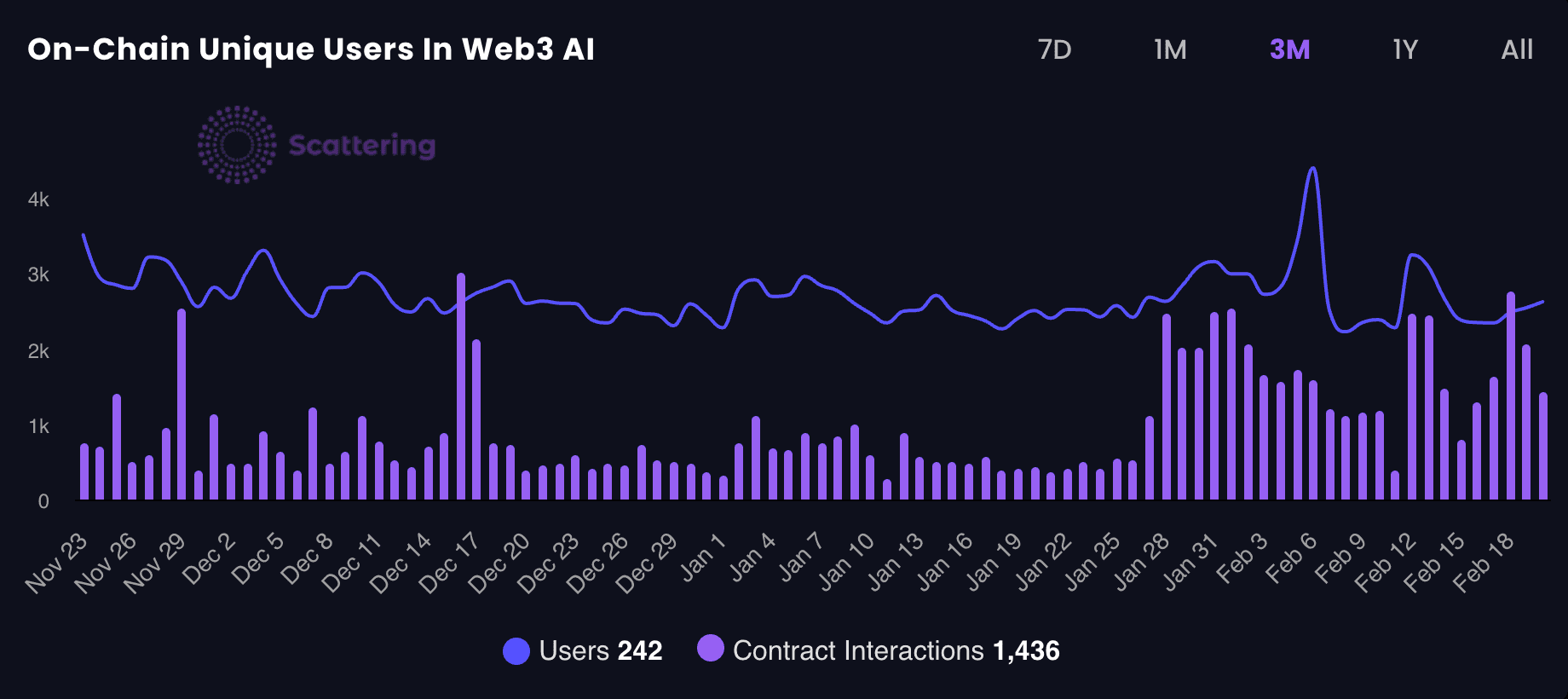
Source: https://scattering.io/agent_store/unique_users
Among the agentic projects that dominate the space, yield-seeking agents remain at the center of the conversation alongside trading and portfolio optimization agents.
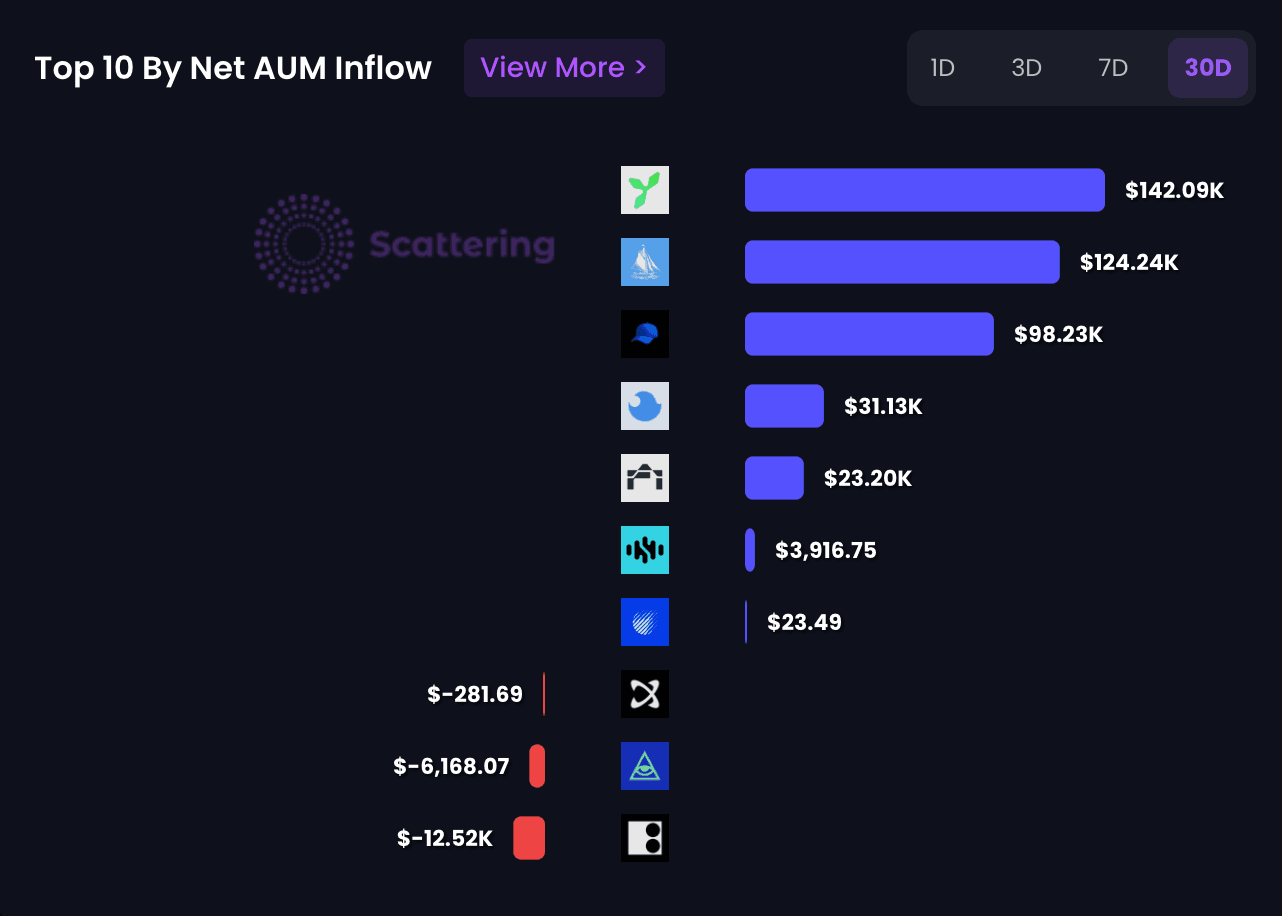
Scattering’s agentic finance chart of net AUM inflows over the last 30 days. Source: https://scattering.io/
We’re also seeing greater institutional interest and active investments in building the rails for agentic finance to grow exponentially. Some examples include the Grayscale Decentralized AI Fund in late 2025, Robinhood’s Cortex assistant released for its retail users, and Visa’s Trusted Agent Protocol for AI commerce, designed using Coinbase's x402 payment standard.
x402 continues expanding on new chains, now also supporting BSC and Polygon in addition to the already-supported ones (Base and Solana). Despite deceleration due to recent market conditions, agentic payments volume remains strong, with x402 cumulative volume surpassing $50M. Most of the x402 volume in the last 30 days has been processed by Virtuals².
Emerging Trends
If you’re active on X, you may have noticed the recent timeline takeover by OpenClaw-style agents built on the OpenClaw core framework, such as clawdbotatg. These agents can autonomously make payments, mint tokens, perform AI-powered crypto trading, and participate in prediction markets.
Bankr has become a widely used execution layer among these OpenClaw agents, providing programmable wallets and automated fee redirection to help cover operational costs. And it’s not just Bankr there are 80+ projects on Base already building agentic infrastructure for OpenClaw-style agents, enabling them to participate in agentic finance³.
Emerging agents of all types are also actively leveraging the recently launched ERC-8004 to register their identities as NFTs and build reputational history to prove their legitimacy. Since ERC-8004 was launched on January 29th, 24k+ agents have already registered⁴.
Compounding on all the standards we have mentioned in previous reports (ERC-8004, x402, AP2, ACP), crypto infrastructure is proving to be the most powerful bedrock for AI agents to hold, move, and create monetary value without gatekeepers⁵. A recent example is Agentic Wallets, recently introduced by Coinbase.
The Agentic Finance Landscape Q1 2026
At the start of 2026, retail users are the early adopters of agentic finance, while institutions are paying attention but are still far from full-on adoption. Below, we list the most legitimate retail-oriented AgentFi products.
Cambrian employs a strict filter for inclusion in the Agentic Finance Landscape: We don’t list projects still in development or in internal testing, nor those that use only an LLM interface but require humans to make the “hard” decisions. This ruled out many projects.
Trading and Portfolio Optimization Agents
Trading agents are the first product most people think of when they hear “agentic finance.” These agents manage users' funds by rebalancing portfolios or picking assets to buy or sell. Decision-making in trading requires access to an exchange, assets to trade, a budget, trading guidelines or rules, and high-quality data. The agentic tools below provide support for one or more of these aspects.
Yield Agents
Earning yield in AgentFi takes many forms. The most popular at the moment is through lending protocols, where borrowers pay interest, which lenders receive as yield. Users can also provide liquidity in DEX (Decentralized Exchange) liquidity pools to receive trading fees, or deposit funds into curated vaults that allocate capital across multiple venues. The agents below help users find the best risk-adjusted returns across these strategies.
Note: In earlier versions of this report, we split LP and Yield agents into different categories. As time has progressed, we’ve found that more and more projects are combining multiple yield-generating strategies into their strategies, including, but not limited to, lending, LPs, and spot trading.
Prediction and Betting Agents
Prediction markets are platforms where users can bet on the outcomes of future events, such as election results or sports competitions. These markets often require tracking news and other real-world information that can unfold and change in unexpected ways in real-time. Prediction markets are one of the most exciting emerging categories within AgentFi. Agents can consume and track real-world event information across a wider range of data sources than humans can manually, making them ideal participants in prediction markets.
We expect this segment to grow in 2026. Academic studies, such as this one from the Federal Reserve, are showing that prediction markets can provide decision-makers with valuable insights. Meanwhile, the CFTC is asserting its authority to legalize prediction markets over state objections.
Sentiment, Fundamentals, News, Technical Analysis Agents
Investors often use market analysis to determine what to buy and sentiment analysis to decide when to buy or sell. LLMs have significantly transformed both market and sentiment analysis by scaling the amount of data analyzed, the speed at which it is analyzed, and creating a deeper contextual understanding by identifying connections between data sources⁶. A distinguishing feature of analysis agents and the agents above is that they do not take direct actions; instead, they provide informative guidance. There are many analysis agents; we only list a few below.
What’s next for agentic finance in 2026?
Q1 2026 has been testing the crypto infrastructure under stress. After peaking above $4 trillion, the total crypto market cap has corrected amid macro uncertainty. Yet, BlackRock’s IBIT (iShares Bitcoin Trust) recorded a historic $10 billion single-day trading volume in early February⁷; tokenized RWAs have surged past $20 billion (with tokenized Treasuries alone reaching $8–10 billion⁸, up from $5.5 billion in Q3 2025); and stablecoin supply has climbed to $310 billion⁹.
Regulatory clarity and the convergence of DeFi, TradFi, and AI
The regulatory landscape keeps shifting towards applying clear rules for the crypto economy to continue growing. We see this as a major step forward, as we believe regulatory clarity is key to enabling TradFi to channel more capital onto crypto rails. As examples, the SEC under Chair Paul Atkins has announced an "innovation exemption" and forthcoming "Regulation Crypto" rulemaking, while the CLARITY Act (establishing clear CFTC/SEC jurisdiction) has a realistic path to passage before the November 2026 midterms¹⁰. In the meantime, Hong Kong is getting ready to issue its first stablecoin licenses in March 2026; the UK's FCA (Financial Conduct Authority) has opened its regulatory sandbox supporting UK-issued stablecoins¹¹; and MiCA's full CASPs (crypto-asset service providers) compliance deadline arrives July 2026¹², with Circle's EURC emerging as the dominant compliant euro stablecoin after last year saw USDT delisted across several EU exchanges.
The combination of regulatory clarity with battle-tested crypto infrastructure is laying the foundations for institutional capital to move onchain and for agentic finance to mature at scale. In the coming months, we expect continued growth in both institutional adoption and agentic finance, but on parallel tracks. Agentic finance must first establish a credible performance track record for retail users before institutions allocate meaningful capital; only then will these two trajectories converge.
We also anticipate sustained growth in stablecoin usage and agentic payments as new autonomous-agent trends (such as OpenClaw) emerge and require programmatic access to APIs, compute, and third-party services. Stablecoins, as the native settlement layer for machine-to-machine transactions, are positioned to be a critical catalyst for agentic finance's mainstream adoption.
To stay ahead of the agentic finance curve:
- Sign up for the Cambrian newsletter to be notified of our next post.
- Join the Cambrian Discord to stay up to date with Cambrian news.
- If you’re a developer building agentic applications, register for the Cambrian API limited-access advanced release cohort.
Lastly, connect with me on X to share your ideas or to let me know if I’ve missed anything in this year's first edition of the agentic finance landscape.
Note from the editor: the Cambrian team has changed the naming convention of the quarterly Agentic Finance Landscape reports to be titled with the quarter they’re released in, instead of focusing only on the previous quarter.
About the author
Sam Green is the founder of Cambrian Network, the financial intelligence layer for agents. Before Cambrian, Sam co-founded and served as CTO at Semiotic Labs, leading AI and verifiability efforts for The Graph. Sam also helped develop Odos, a leading crypto trading platform that has handled $100 billion in trading volume for 3 million users. Previously, Sam was an AI and cryptography researcher at Sandia National Labs. Sam holds a master's degree in applied mathematics and earned a Ph.D. in computer science at UC Santa Barbara.
About Cambrian
Cambrian is the financial intelligence layer for agents. Cambrian’s API provides real-time and historical blockchain data for agentic DeFi applications. We're focused on providing verifiable financial insights, including yield, liquidity positions, risk, whale activity, and market sentiment.
This content is for general information only and does not constitute financial, investment, legal, or tax advice. Accuracy is believed reliable at the time of publication, but is not guaranteed, and opinions may change without notice. You should conduct your own research and consult qualified professionals before making decisions. References to third‑party projects do not imply endorsement. The author and publisher accept no liability for any loss or damage arising from reliance on this material.
Sources:
¹ https://scattering.io/agent_store/unique_users
² https://scattering.io/x402
³ https://x.com/AIonBase_/status/2019752568595833185?s=20
⁴ https://x.com/ethereum/status/2019895379945484553?s=20
⁵ https://a16zcrypto.com/posts/article/ai-needs-crypto-now/
⁶ https://scholar.google.com/scholar?hl=en&as_sdt=0%2C44&q=can+LLMs+prove+financial+guidance&btnG=
⁷ https://www.coindesk.com/markets/2026/02/06/blackrock-s-bitcoin-etf-hits-usd10-billion-volume-record-hinting-at-capitulation
⁸ https://blockchainreporter.net/tokenized-rwa-market-tops-20b-as-institutions-pour-into-on-chain-treasuries
⁹ https://news.bitcoin.com/stablecoin-market-opens-2026-at-a-new-310b-record/
¹⁰ https://www.skadden.com/insights/publications/2026/2026-insights/sector-spotlights/with-supportive-new-regulations-digital-assets-are-likely-to-proliferate-in-2026
¹¹ https://www.fca.org.uk/news/press-releases/stablecoin-payments-priority-2026-fca-outlines-growth-achievements
¹² https://sumsub.com/blog/crypto-regulations-in-the-european-union-markets-in-crypto-assets-mica/